
Zojirushi NL-GAC10 Umami Micom Rice Cooker Review: Worth the Wait?
"A thoughtfully engineered micom cooker whose signature Umami and GABA brown-rice cycles set it apart for eaters who want maximum flavor from every grain."
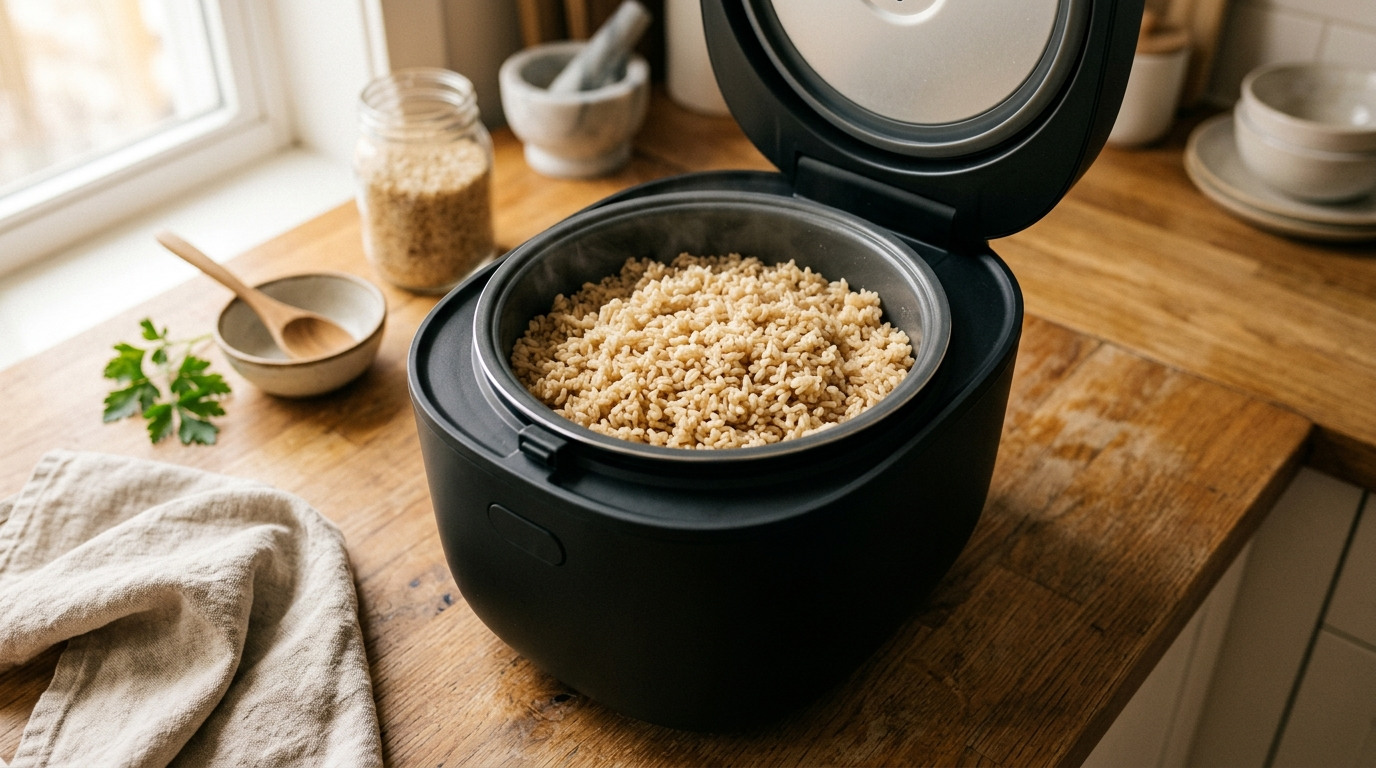
If you’ve browsed Zojirushi’s lineup lately, the NL-GAC10 Umami Micom Rice Cooker stands out for one reason printed right on the nameplate: Umami. Unlike a basic on/off cooker, this 5.5-cup machine uses micom (microcomputer) “fuzzy logic” to manage heat throughout the cook, and it’s one of the few models in its price band to pair a dedicated Umami soaking cycle with a true GABA brown-rice setting.
Disclosure: We may earn a commission when you buy through links on this site. As an Amazon Associate, Fuzzy Logic Rice Cooker earns from qualifying purchases. This is an editorial review synthesized from manufacturer specifications and verified owner feedback — we did not independently lab-test this unit, and our star rating is an editorial verdict, not an aggregated score.
What is the Zojirushi NL-GAC10?
The NL-GAC10 (sold in black as the NL-GAC10BM, ASIN B08ZHRMGJ2) is Zojirushi’s “Umami Micom Rice Cooker & Warmer.” Zojirushi lists it within its Micom category — the middle rung of its technology ladder, sitting below the induction-heating (IH) and pressure-IH flagships but well above conventional single-switch cookers. According to the manufacturer’s own product page, it carries the badges for Delay Timer, Extended Keep Warm, Quick Cooking, GABA Brown, and Made in Japan, with a capacity of up to 5.5 cups (the sibling NL-GAC18 covers 10 cups).
That “Made in Japan” detail matters to a lot of buyers: Zojirushi’s Japan-built micom cookers have a long-standing reputation for fit, finish, and longevity that shows up again and again in owner reviews.
Who the NL-GAC10 is for
This is a cooker for people who care about the quality of their rice, not just how fast it lands on the table. It’s a strong fit if you:
- Cook for one to four people regularly and want a generous batch with leftovers
- Eat a lot of white, sushi, or mixed rice and want grains that are fluffy and distinct rather than clumpy
- Are curious about brown rice and want a machine with a proper GABA cycle (see our best rice cooker for brown rice guide)
- Value build quality and a long service life over the lowest sticker price
It’s less ideal if you need a 10-cup machine for a big family, if you want the fastest possible cook (the Umami and GABA cycles are deliberately slow), or if you’re chasing the crust and pinpoint precision of induction heating.
Key specs and menus
Here’s what the NL-GAC10 brings to the counter, based on Zojirushi’s published specifications:
- Capacity: 5.5 cups (uncooked, standard 6-oz rice cups) — enough for a small-to-medium household
- Technology: Micom fuzzy logic — a microcomputer that adjusts heating power and timing in real time rather than cooking to a single fixed temperature
- Construction: Made in Japan, with a thick, rounded inner cooking pan and nonstick coating
- Keep warm: Automatic keep warm plus an Extended Keep Warm mode and a reheat cycle
- Convenience: A delay timer for setting up rice in advance, and a Quick Cooking cycle for faster white rice
The menu settings are where this cooker earns its name. Beyond the expected white, mixed, sushi, sweet, and brown-rice options, it includes:
- Umami — the signature extended soak-and-cook cycle
- GABA brown rice — a long, low-temperature activation cycle for brown rice
- Quick Cooking — a shorter cycle when you’re in a hurry
A typical micom control panel pairs a small LCD with dedicated menu keys — a layout Zojirushi has refined across its fuzzy-logic line for years.
How micom fuzzy logic actually helps
The “micom” in the name is the real workhorse. A conventional rice cooker has one job: heat until the water is gone, then shut off. A micom cooker, by contrast, runs a small program that senses conditions inside the pot and modulates the heat — warming up gradually, holding a soak, ramping to a boil, then tapering for a final steam. This is the “fuzzy logic” part: instead of binary on/off heating, the machine adjusts in fine increments to match how the rice is actually cooking.
In practical terms, that’s why micom cookers consistently produce fluffier, more evenly cooked grains with less attention from you. It’s also why this whole class of machines sits in our micom rice cookers coverage — the technology is the story, and the NL-GAC10 is a textbook example.
The Umami setting, explained
“Umami” is the Japanese word for the savory “fifth taste” — the deep, brothy character associated with foods rich in glutamate, formally identified as a distinct taste in 1908. Zojirushi borrowed the term for this cooker’s headline feature.
The Umami setting isn’t a separate ingredient; it’s a different process. Instead of moving straight to a rolling cook, the cycle first soaks the rice, then extends the cooking at a more gradual, controlled temperature. The idea — Zojirushi’s stated goal for the setting — is to give the grains more time to release their natural sugars, so the finished rice tastes sweeter and more aromatic. Owners who use it tend to describe the result as noticeably fuller-flavored white rice, with the obvious trade-off being a longer wait.
GABA brown rice: the slow route to better brown rice
Brown rice is a whole grain — only the inedible hull is removed, so the bran and germ stay intact — and it notoriously needs longer cooking than white rice (research has put typical cook times around 35–51 minutes). The NL-GAC10’s GABA brown-rice cycle leans into that: it holds the soaked rice at a low, warm temperature for an extended period before the actual cook, a process Zojirushi ties to the activation of gamma-aminobutyric acid (GABA) in the germinating grain.
The practical payoff owners report is brown rice that’s tender rather than crunchy, with a nuttier flavor than a quick cycle produces. If you’ve ever bounced off brown rice because your old cooker turned out chewy, half-cooked grains, this is the setting designed to fix exactly that.
What owners say (consensus, not our testing)
Aggregating the recurring themes across verified purchaser reviews — and being clear that this is consensus reading, not our own lab data — a clear picture emerges.
The praise centers on three things. First, rice quality: across menus, owners describe consistently good texture with minimal burned or stuck grains. Second, durability: many reviewers mention years of daily use without issue, consistent with Zojirushi’s made-in-Japan reputation. Third, the GABA and Umami cycles specifically — once people try them, they tend to become the default.
The gripes are just as consistent. The biggest is cook time: the Umami and GABA cycles are long, which surprises buyers expecting instant rice. The inner lid and steam cap need regular cleaning. A few owners find the beeps and the small LCD dated. And, predictably, the price draws some “I didn’t expect to pay this much” reactions relative to generic micom cookers.
None of these are deal-breakers, but they’re real. This is a cooker that rewards patience and a slightly higher budget.
For a side-by-side, our Zojirushi NS-TSC10 review covers a closely related micom model that skips the Umami and GABA extras and lands at a lower price.
Honest bottom line
The Zojirushi NL-GAC10 is a “buy it for the features, accept the wait” kind of appliance. If the Umami and GABA brown-rice cycles genuinely appeal to you — and you cook rice often enough to use them — it’s one of the most rewarding micom cookers in its range, with the made-in-Japan build quality to justify keeping it for years. If you just want hot white rice fast, or you genuinely need 10 cups, a cheaper or larger micom model will serve you better and faster.
Our editorial verdict: 4.5 out of 5. It loses half a point only for the slow specialty cycles and the premium price — neither of which is a flaw so much as the cost of what makes it special. You can check the current price on Amazon.
Frequently asked questions
Does the NL-GAC10 use induction heating? No. It’s a micom (microcomputer fuzzy-logic) cooker with a conventional heating element, not an induction or pressure model. Induction heating is reserved for Zojirushi’s higher-tier IH and pressure-IH machines.
What’s the difference between the NL-GAC10 and NL-GAC18? They’re the same cooker in different sizes. The NL-GAC10 is the 5.5-cup version; the NL-GAC18 is the 10-cup version built for larger households.
How long does the Umami cycle take? It’s deliberately slow. The extended soak-and-cook approach runs noticeably longer than a standard white-rice cycle — often two hours or more. Plan around it rather than racing against it, and use the delay timer to have it finish exactly when you need it.
Is it worth it if I only cook white rice? Possibly not at full price. The NL-GAC10’s value proposition is its specialty cycles. If you exclusively cook plain white rice and want speed, a less expensive micom model — like the NS-TSC line — covers the basics well for less.
How does keep warm work? It switches to automatic keep warm after cooking, and offers an Extended Keep Warm mode plus a reheat function for rice that’s been sitting. Plan to clean the inner lid and steam vent regularly for best results.
Related: Zojirushi Rice Cooker Error Codes: What H, C, and E Displays Mean and How to Fix Them.
✅ Pros
- Made-in-Japan build quality that owners repeatedly describe as durable and long-lasting
- Distinctive Umami and GABA brown-rice settings that noticeably deepen flavor
- Micom fuzzy-logic cooking that adjusts heat on the fly for consistent, even results
- Automatic, Extended, and reheat keep-warm modes hold rice for hours without drying it out
- Compact 5.5-cup footprint that suits small households without hogging counter space
❌ Cons
- Specialty Umami and GABA cycles are deliberately slow — often two hours or more
- Premium price relative to standard micom models with fewer features
- 5.5-cup capacity is small for larger families or batch cooking
- Plain housing and a small LCD feel dated next to pricier induction models
Ready to Upgrade Your Rice Game?
The Zojirushi NL-GAC10 is waiting for you. Perfect rice, every time.
Buy on Amazon 🍚 🛒