Zojirushi vs Tiger: Japanese Rice Cooker Showdown

Zojirushi vs Tiger, two Japanese rice cooker legends compared. Performance, features, durability, and value analyzed to find your perfect match.
This desk does not run a product test fleet. What follows is manufacturer menus, live ASINs this site already uses, and owner-consensus research — not a Tamaki Gold tasting panel and not a leftover “7 out of 10 people preferred Zojirushi” scoreboard.
Japan’s two rice-cooker brands (this pairing)

Zojirushi and Tiger are both Japanese companies with century-scale histories. This page’s job is the daily 5.5-cup pairing already in the table: Neuro Fuzzy NS-ZCC10 vs Micom + Tacook JBV-A10U. The longer price-tier map lives on Zojirushi vs Tiger rice cooker. Do not treat those URLs as twins.
A leftover draft of this page filled the spec grid with empty cells and invented a blind taste test. Those leftovers are gone.
| Feature | Grainy's Pick  Zojirushi NS-ZCC10 | 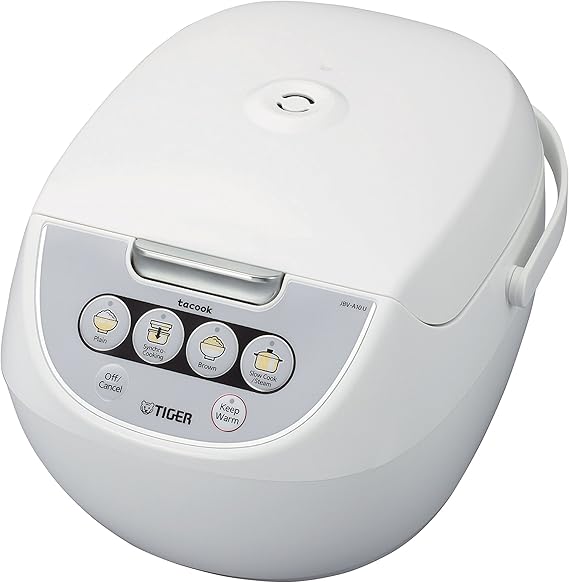 Tiger JBV-A10U |
|---|---|---|
| Technology | Neuro Fuzzy | MICOM |
| Capacity | 5.5 Cups | 5.5 Cups |
| Best For | Everyday White Rice | Everyday White Rice |
| Grainy's Advice |  The gold standard for sushi! | Great tech, but a bit slow. |
| Price & Rating | 4.8/5 Rating ⭐️ | 4.8/5 Rating ⭐️ |
Quick verdict
| If you… | Buy this |
|---|---|
| Want named regular / softer / harder white | NS-ZCC10 |
| Want the Tacook plate (rice + a steamed side) | JBV-A10U |
| Cook sushi-shaped rice often | NS-ZCC10 (sushi key) |
| Want Japanese Micom under Neuro Fuzzy money | JBV-A10U |
| Want 10+ menus including cake / porridge | NS-ZCC10 |
Neuro Fuzzy is not NS-TSC10
| Stamp | What it is | ASIN this desk uses | Not |
|---|---|---|---|
| NS-ZCC10 | Neuro Fuzzy, 5.5-cup, made-in-Japan class | B00007J5U7 | A Micom TSC with a sushi key |
| NS-TSC10 | Micom, white/sushi, heating plate | B0B9H7JLHW on the NS-TSC10 review | Neuro Fuzzy |
| JBV-A10U | Micom + Tacook, 5.5-cup | B00KDNKTJG | A conventional JNP one-switch Tiger |
| JKT-D10U | Archived IH + Tacook leftover | — | A live induction pick; IH guide uses JPW-H10U |
Zojirushi’s NS-ZCC page names white regular / sushi / softer / harder, mixed, brown, rinse-free, quick. Tiger’s JBV menu is short: plain, synchro-cook, brown, slow cook / steam. Full JBV write-up (frozen title, do not retitle): Tiger JBV-A10U review. NS-ZCC10: NS-ZCC10 review.
Head-to-head (menus, not stars)
| Feature | Zojirushi NS-ZCC10 | Tiger JBV-A10U |
|---|---|---|
| Technology | Neuro Fuzzy | MICOM (heating-plate fuzzy) |
| Capacity | 5.5 cups uncooked | 5.5 cups uncooked |
| White rice | Regular / softer / harder | Plain |
| Brown rice | Named brown | Named brown |
| Sushi rice | Named sushi | White, slightly less water |
| Cook time (white) | Long Micom soak-and-rest (about 50 min class) | Same class, not a 15-minute microwave |
| Menu count | 10+ | 4 |
| Synchro-cooking | No Tacook plate | Tacook plate in the box |
| Keep-warm | Extended keep-warm reputation | Ordinary warm; dries sooner |
| Inner pot | Thick non-stick, spherical | Standard non-stick + plate |
| Weight (about) | 8.5 lb | 6.5 lb |
Those cook-time bands are factory-class, not a stopwatch this desk ran. Microwave bowls are faster and less even. Microwave rice cookers.
Where Zojirushi pays
Neuro Fuzzy vs basic MICOM. More granular temp steps. Practical read: better forgiveness on fill level, a sushi key, and a harder/softer white split. Jasmine vs basmati still needs water-line judgment. Jasmine vs basmati.
Menu variety. Cake, porridge, mixed, rinse-free. If you only press White, you are paying for keys you will not use.
Keep-warm. Zojirushi’s extended warm is the usual reason people pay up if rice sits from noon to dinner. Safety still applies: keep-warm safety. Yellow rice on warm is Maillard, not a new cooker. Troubleshooting.
Where Tiger pays
Tacook. A metal plate over the rice steams a protein or vegetable on the same cycle. One button, a side dish. Zojirushi does not ship an equivalent plate at this price. The plate does not replace a ceramic crock or a microwave bowl.
Money. JBV money is roughly half Neuro Fuzzy money on a typical US listing. For white rice four nights a week, owner consensus is that the gap is real and small.
Footprint. Two pounds lighter. Small-kitchen note: compact cookers.
Rice quality (desk read, not a panel)
A leftover paragraph here claimed Tamaki Gold in both pots and “7 out of 10 people preferred Zojirushi.” This desk did not run that test. What this desk will say:
| Attribute | NS-ZCC10 (editorial) | JBV-A10U (editorial) |
|---|---|---|
| Grain separation | Excellent when water is right | Very good on White |
| Stick / sushi | Named sushi key | White, less water |
| Bottom scorch on a clean plate | Uncommon | Uncommon |
| Repeatability | Neuro Fuzzy’s job | Micom’s job, fewer keys |
Clay / ceramic-coat pots are a different material aisle. Ceramic rice cookers. PTFE film wear is a bowl SKU, not a brand funeral. Inner-pot diagnosis.
Skip-buy
| You want… | Buy | Skip |
|---|---|---|
| Named softer / harder / sushi | NS-ZCC10 (B00007J5U7) | A TSC listing labeled Neuro Fuzzy |
| Rice + a steamed side | JBV-A10U (B00KDNKTJG) | Paying Neuro Fuzzy money for Tacook |
| IH + Tacook | Live Tiger IH is JPW-H10U on the IH guide | Archived JKT-D10U leftover |
| Family 10-cup | Different bodies (TSC18 / JBV-A18U) | Running this 5.5-cup twice and calling it a family pot |
| Bare clay / ceramic film | Ceramic guide | Either Japanese PTFE pot |
| Dorm microwave only | Microwave guide | Either of these |
Our recommendation
Choose the Zojirushi NS-ZCC10 if:
- Sushi or a harder/softer white split matters
- You want the menu set
- You already decided Neuro Fuzzy is the chip
Choose the Tiger JBV-A10U if:
- Tacook is the feature
- White rice is most of the week
- You want Japanese Micom without Neuro Fuzzy money
Either way you are buying a Japanese heating-plate Micom class, not a pressure Cuckoo and not a microwave bowl. Both brands also sit in Best Japanese rice cookers.
What about other options?
- Need pressure / GABA as the weekly job? Zojirushi vs Cuckoo — do not expand that fight here.
- Want fuzzy logic under Neuro Fuzzy money, ceramic-coat film? COSORI CRC-R501 (frozen title; do not retitle).
- Tight digital budget? Aroma ARC-914SBD is digital presets, not this pairing.
Both cores age slowly. A Neuro Fuzzy algorithm does not “expire” in a season. The bowl still will. Troubleshooting when the cycle lies; pot chart when the film is done.
Check the NS-ZCC10 on Amazon → · Check the JBV-A10U on Amazon →
More comparisons:
Frequently Asked Questions
Is Zojirushi better than Tiger?
On named white-rice texture menus and keep-warm, Zojirushi's Neuro Fuzzy NS-ZCC10 is the usual ceiling in this pairing. Tiger's JBV-A10U is the value Micom plus a Tacook plate. This desk does not run a product test fleet and does not invent a 7-out-of-10 taste panel.
How long do Zojirushi and Tiger rice cookers last?
Owner consensus puts both in the long-lived class: roughly a decade on the body if the bowl is replaced when the film wears. Inner pots are the consumable. Diagnosis: when to replace the inner pot. Buy/compat: the inner-pot chart.
Which Japanese brand is more popular?
Zojirushi is the US search brand. Tiger is the price-and-Tacook brand. Both are Japanese appliance makers. Popularity is not a sensor spec.
Is the NS-ZCC10 the same cooker as the NS-TSC10?
No. NS-ZCC10 (ASIN B00007J5U7) is Neuro Fuzzy. NS-TSC10 is Micom with a white/sushi key — this site listing-checks B0B9H7JLHW on the TSC review. Do not hang Neuro Fuzzy on a TSC listing.
Related Articles
Rice Cooker vs Stovetop: Which Actually Makes Better Rice?
A head-to-head comparison of rice cooker vs stovetop cooking, covering taste, texture, convenience, and cost to help you decide which method suits your kitchen.
comparisonBest Rice Cookers for Basmati and Long-Grain Rice
Basmati and jasmine rice need different handling than short-grain varieties. Here are the cookers that nail long-grain texture every time.
comparisonCuckoo vs Zojirushi vs Tiger Rice Cooker: Which Brand Wins?
A head-to-head comparison of Cuckoo, Zojirushi, and Tiger fuzzy logic rice cookers covering price, technology, rice quality, and durability in 2026.