
Zojirushi Neuro Fuzzy Rice Cooker Review (NS-ZCC10): Still the Benchmark in 2026
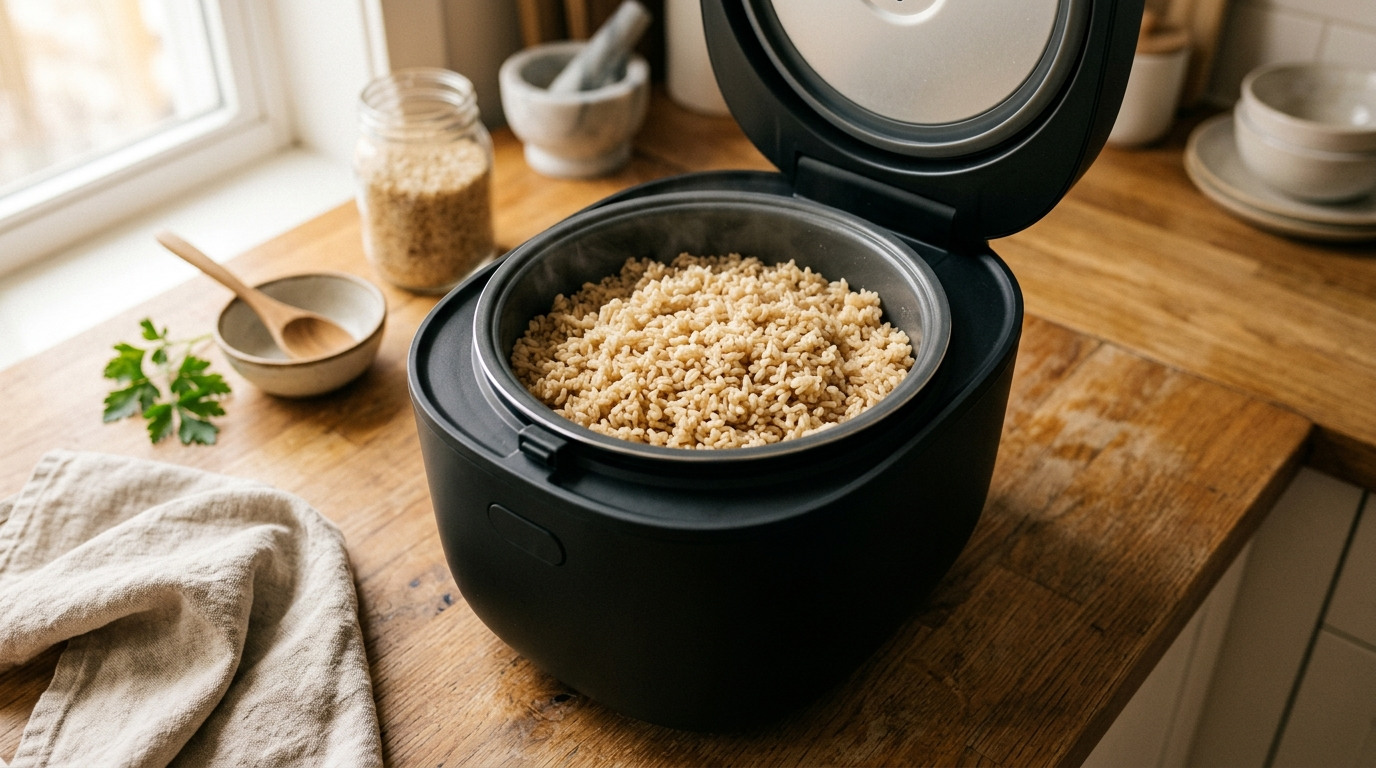
A research-based review of the Zojirushi NS-ZCC10 Neuro Fuzzy rice cooker: how its fuzzy-logic micom controller actually works, what owner reviews consistently praise, where it falls short, and who should buy one in 2026.
As an Amazon Associate we may earn a commission from qualifying purchases made through links on this page, at no extra cost to you.
If you have spent any time reading about rice cookers, you have already met the Zojirushi NS-ZCC10. It is the machine most people mean when they say “Neuro Fuzzy,” and it has been a default recommendation in enthusiast communities for well over a decade. This review is a research-based synthesis: we have drawn on Zojirushi’s published product specifications, the recurring patterns in thousands of verified owner reviews on the Amazon product page and community roundups like our best rice cookers according to Reddit guide, and food-safety guidance from public health bodies. The goal is to tell you what the evidence actually supports — and where this cooker’s limits are — before you spend premium money.
What “Neuro Fuzzy” actually means
The NS-ZCC10 is a micom (microcomputer) rice cooker: a small chip runs a programmed cooking curve instead of the crude “boil until the water is gone” logic of a basic thermostat cooker. Zojirushi’s “Neuro Fuzzy” branding describes the flavor of that micom brain — a fuzzy-logic controller that takes readings from the pan’s temperature sensor during the cook and nudges the remaining time and heat rather than blindly following a fixed schedule. In practice, that is what makes the difference between “edible” and “the same every time”: if your rice is slightly wet or the kitchen is cold, the cooker compensates mid-cycle.
Two clarifications are worth making up front. First, Neuro Fuzzy is not a separate heating technology — the NS-ZCC10 uses a conventional heating plate underneath the pan, not induction. The brain is fuzzy logic; the heat is ordinary. Second, “fuzzy logic” and “micom” are not synonyms even though marketers blur them. We break the terminology down properly in Neuro Fuzzy vs Micom rice cookers and Fuzzy Logic vs Micom vs Neuro Fuzzy explained, and there is a deeper primer in What is a Neuro Fuzzy logic rice cooker?
Design and key specifications
Per Zojirushi’s official product page, the headline facts are:
- Capacity: 5.5 cups of uncooked rice, measured with the included 180 ml rice cup — not a US measuring cup. That quirk trips up new owners constantly, so see our explainer on why the included rice cooker cup is 180 ml. If you are cooking for a crowd, here is how much cooked rice one cup of uncooked rice makes.
- Inner pan: a thick, spherical, nonstick-coated pan. The rounded shape is designed to distribute heat and circulate convection more evenly than a flat-bottomed pot.
- Menu settings: dedicated programs for white/mixed rice, sushi rice, porridge, sweet rice, brown rice, and a quicker white-rice cycle.
- Convenience features: an LCD clock, two programmable delay timers, automatic keep-warm, a reheat function, a retractable power cord, and a melody chime at the end of the cycle.
- Origin: made in Japan.
The physical design is unapologetically functional rather than handsome: a rounded plastic shell, a clear lid window, and dense button-and-label paneling. The control layout rewards a one-time read of the manual — our guide to using a Zojirushi rice cooker walks through the timer programming, which is the one genuinely non-obvious part.
How it performs, by rice type — the owner consensus
Because this article synthesizes owner feedback rather than bench measurements, the useful signal is not any single review; it is how tightly the feedback clusters.
White and mixed rice is where the NS-ZCC10 earned its reputation. Across an enormous base of owner reviews on Amazon — an average rating that has long sat comfortably in the mid-4s out of 5, with the live figure worth checking on the product page itself — the recurring language is “restaurant quality,” “consistent,” and “forgiving.” The fuzzy-logic loop is the reason reviewers keep using that last word: rinse habits and water levels that would wreck a cheap cooker barely move the end result here.
Sushi rice is a dedicated menu setting rather than a workaround, and it is one of the most-cited reasons serious home sushi makers buy this exact model. The firmer, glossier grain texture that sushi rice demands comes out of the program reliably, which is why it features in our best rice cookers for sushi rice picks.
Porridge and congee benefit from the dedicated Porridge setting’s lower, slower curve. Owners report silky results without the pot-scraping and boil-overs that stovetop congee is known for; we cover the category in full in the best rice cookers for congee.
Brown rice is the honest asterisk on this review. The Brown setting produces well-received results — you can see how the technique differs in how to cook brown rice in a rice cooker and our best rice cookers for brown rice guide — but the cycle is long. This is the single most common performance complaint in owner feedback: brown rice routinely takes around twice as long as the white-rice cycle, so this is a “start it after lunch” appliance for whole-grain households.
Living with it: keep-warm, cleaning, and longevity
The keep-warm function holds rice at serving temperature automatically after cooking, and the reheat key bumps it back up after the pot has sat a while. One caution belongs in any honest review: holding cooked rice at warm temperatures for extended periods is a known food-safety risk, because Bacillus cereus spores survive cooking and can grow when rice sits in the danger zone. The NHS guidance on reheating rice is to cool rice quickly, refrigerate it promptly, and reheat it once — so treat keep-warm as a mealtime convenience, not a storage method. We cover the practical limits in how long rice can safely stay on keep warm.
Maintenance is simple but non-negotiable: the nonstick inner pan and the detachable inner lid need hand-washing with a soft sponge, and metal utensils will scratch the coating. Zojirushi’s own care instructions warn against dishwashers and abrasive pads for these parts, and the coating is the component long-term owners most often end up replacing — our inner pot replacement guide covers compatibility and sourcing. For everything else, the routine in how to clean a rice cooker properly keeps the steam vent and lid gasket in shape, which is where most “my cooker smells odd” reports actually originate.
On durability: the most striking pattern in long-run owner feedback is how many people describe a decade of regular use. That is anecdotal rather than laboratory data, but its consistency across review corpora is unusual for a small kitchen appliance and is a real part of what you are paying for.
Where the NS-ZCC10 falls short
No cooker this popular is without complaints, and the criticisms are consistent enough to plan around:
- No induction heating. The heating element is a conventional plate. Zojirushi’s own NP-HCC10 moves to induction heating for stronger, more even heat; our NP-HCC10 vs NS-ZCC10 comparison and the broader is an induction rice cooker worth it analysis cover when that upgrade matters. For plain white rice, the honest answer is: not much.
- Slow whole grains. As above, brown rice is a long wait. Households that eat mostly brown rice and want speed may be happier with a pressure model — see the best pressure rice cookers.
- Capacity mismatch for singles. 5.5 cups is family-sized, and small batches of one cup do come out well but leave you storing a large appliance. Solo cooks should read the best small rice cookers for one person first.
- Price relative to the competition. The NS-ZCC10 costs several times what a basic Aroma does. Our Aroma vs Zojirushi breakdown and the honest accounting in is a Zojirushi rice cooker worth it are the right reads before committing.
Who should buy it — and who should not
Buy the NS-ZCC10 if you eat rice most days, you cook for two or more people, and your priorities are consistency and durability over speed or gadget count. It is also the easy call for sushi rice and congee devotees. Families sizing up from a cheap cooker will notice the difference immediately; see the best rice cookers for families for how it fits the landscape, and the best Zojirushi rice cookers for the brand’s full ladder.
Look elsewhere if you are on a tight budget, you primarily cook brown rice in a hurry, or you want pressure-cooker speed — and if you are torn between brands, the Zojirushi vs Tiger head-to-head is the fairest fight in this price class.
Check the current NS-ZCC10 price on Amazon before deciding — it fluctuates enough that the value equation shifts with sales.
Frequently asked questions
Is the “Neuro Fuzzy” a model or a technology? Both, informally. Fuzzy logic is the control method; “Neuro Fuzzy” is Zojirushi’s branding for its fuzzy-logic micom controller, and the NS-ZCC10 is the model that made the name famous. The 10-cup sibling is the NS-ZCC18.
Why does the included cup look small? Because a rice-cooker “cup” is the traditional Japanese gō, 180 ml — about three-quarters of a US cup. All the markings inside the pan assume that measure, which is why using an American measuring cup throws off the water lines.
Can it make congee without boiling over? Yes — the Porridge setting runs a gentler curve specifically for that, and it is one of the better-documented uses in owner feedback.
Is the inner pot replaceable? Yes, replacement inner pots are sold separately, and the coating is the part most likely to need replacing after years of use. Treat it gently and it lasts considerably longer.
What is the realistic alternative at this price? A good Aroma machine covers the basics for far less, and Zojirushi’s own NP-HCC10 adds induction heating for a modest step up. The NS-ZCC10 sits in between: conventional heating, exceptional control.
Bottom line
The Zojirushi NS-ZCC10 is not exciting, and that is the point. The fuzzy-logic micom controller, the dedicated sushi and porridge programs, and a build quality that owners routinely describe in multi-year terms make it the safest recommendation in its price class — provided you accept the long brown-rice cycles, the nonstick-pot care requirements, and a capacity aimed at households rather than singles. If your kitchen centers on white, sushi, or porridge rice, the evidence — manufacturer specs and a very large, very consistent body of owner reviews — points the same direction it has for years.
Related Articles
Zojirushi Rice Cooker Error Codes: What H, C, and E Displays Mean and How to Fix Them
Real Zojirushi error codes from six official manuals: H01-H05 sensor overheat with per-model cool-down times, C-series pressure faults, E01/E02 service calls, the blinking clock battery, and what you can fix at the counter.
rice-cooker-maintenanceTiger Rice Cooker Review (2026): How the JBV-A10U Tacook Earns Its Counter Space
A research-based look at Tiger's JBV-A10U-W Tacook rice cooker: how synchro-cooking works, what owners report about brown rice, congee and everyday white rice, how Tiger compares with Zojirushi and Cuckoo, and who should buy it.
rice-cooker-maintenanceCuckoo Rice Cooker Error Codes: What the Display Means and How to Fix Each
Every Cuckoo error display decoded: the official code table from Cuckoo's own manual library, what each one means for your model series, the fixes you can do at the counter, and when to call service.