
Rice Cooker Cup Size in ml: Why the Included Cup Is 180 ml
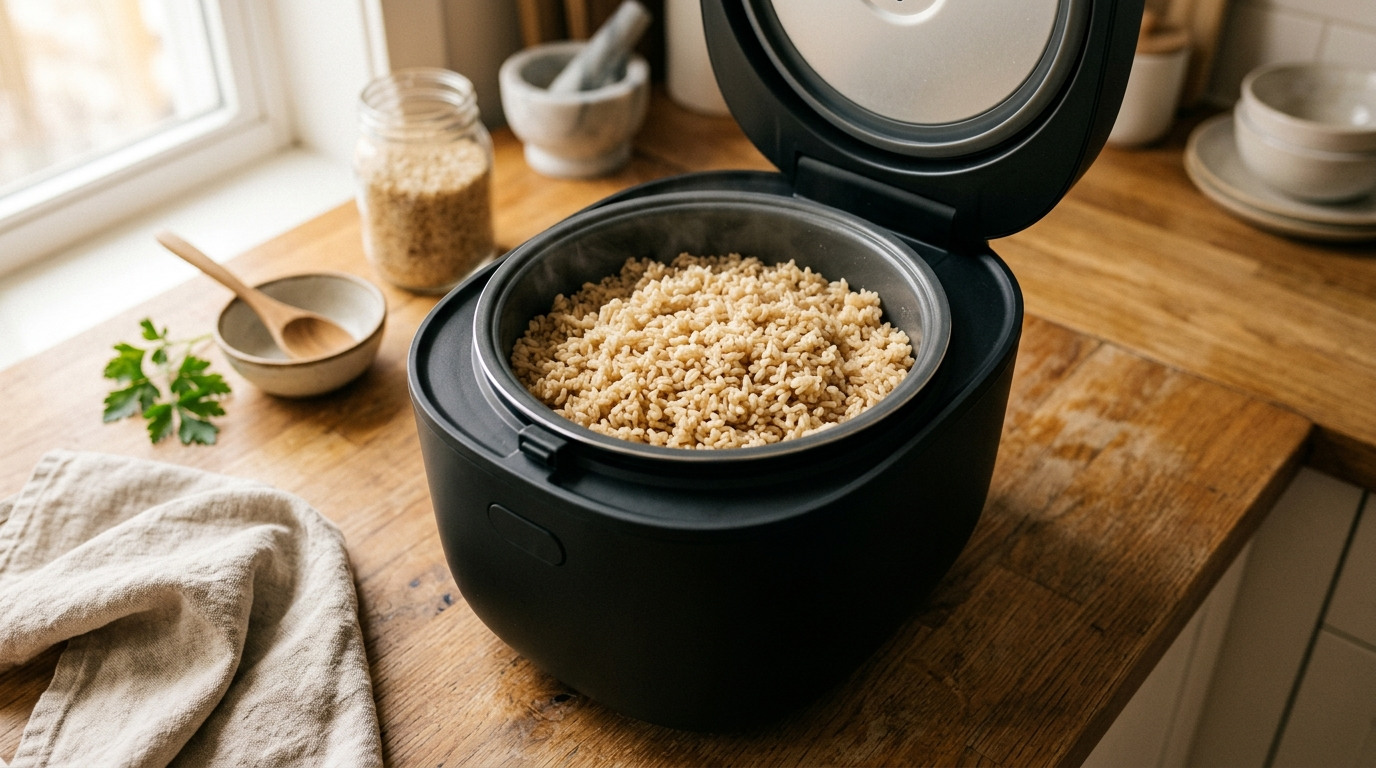
The cup that comes with a rice cooker is 180 ml, not a 240 ml US cup. Here's why it's a Japanese gō, how that throws off your water-to-rice ratio, and how to convert rice cooker cups to standard cups.
This desk does not run a product test fleet. What follows is the Japanese gō, manufacturer capacity language, and live listings this site already uses — not a measuring-cup lab.
As an Amazon Associate we may earn a commission from qualifying purchases made through links on this page, at no extra cost to you.
If you’ve ever measured rice with the small plastic cup that came in the box and then added water from your regular kitchen measuring cup, you may have ended up with rice that was gummy, sticky, or swimming in liquid. The cause is one of the most common — and least obvious — points of confusion in rice cooking: the rice cooker cup is not the same size as a standard cup. Almost every recipe, water-line marking, and capacity rating on a Japanese-style rice cooker is built around a cup that holds 180 ml.
Same cup, not the same milliliters. The ratio sibling is the rice cooker water ratio chart. This page is the cup-band / capacity listing-check.

The Short Answer: One Rice Cooker Cup Is 180 ml
The cup included with virtually every Japanese-style rice cooker — Zojirushi, Tiger, Panasonic, Cuckoo, Cuchen, and the rest — holds 180 ml (about 6 fluid ounces). That is deliberately smaller than both the US cup (around 237–240 ml) and the metric cup (250 ml). In fact, 180 ml is about three-quarters of a US cup (180 ÷ 240 = 0.75).
So whenever a recipe or a water line tells you “1 cup of rice,” it means this 180 ml cup — not whatever mug you grab from the cupboard. Treating the two as interchangeable is the single biggest reason home cooks get inconsistent results from an otherwise foolproof appliance.
Why 180 ml? It Comes From a Japanese Unit Called the “Gō”
The 180 ml size is not arbitrary. It descends from a traditional Japanese unit of volume called the gō (合), which was standardized at roughly 180.4 ml under Japan’s modern measurement law. The gō is one-tenth of a larger unit, the shō (升), and it was historically used to portion out exactly the kinds of things you would cook or serve by volume — most notably rice and sake. (Japanese units of measurement)
Because Japan pioneered and dominated the development of the modern electric rice cooker, the gō became the appliance’s built-in measuring standard. Manufacturers ship a 180 ml cup with the cooker, calibrate the numbered water-line markings inside the inner pot to that cup, and rate the machine’s capacity in gō as well. That legacy is why a “rice cooker cup” and a “gō” are effectively the same thing today, and why the number that matters is 180 — not 240.
Rice Cooker Cups vs. US Cups vs. Metric Cups
Here is where most people get tripped up: “a cup” means different volumes depending on which system you are using. The US alone has more than one official cup. (Cup (unit))
| Unit | Volume | Where it is used |
|---|---|---|
| Rice cooker cup (1 gō) | ~180 ml | Japanese rice cookers worldwide |
| US customary cup | ~237 ml (8 fl oz) | Most US recipes |
| US “legal” cup | 240 ml | US nutrition labels |
| Metric cup | 250 ml | Australia, New Zealand, much of the Commonwealth |
The key takeaway is simple: every one of these standard cups is larger than the rice cooker cup. A single US cup holds roughly 1.3 rice-cooker cups of rice. If you swap one for the other without adjusting, you have quietly changed the recipe.
Cup-band / capacity listing-check
Read the Amazon title for uncooked vs cooked and for the milliliters, not the word “cup” alone.
| Stamp this desk already uses | What the box says | What the cup-band is | Not |
|---|---|---|---|
| NS-TSC10 B0B9H7JLHW | 5.5-cup | 5.5 × 180 ml uncooked (~990 ml / ~1.0 L) | 5.5 US cups of dry rice; not Neuro Fuzzy NS-ZCC10 |
| NS-ZCC10 B00007J5U7 | 5.5-cup | Same 180 ml uncooked class | A TSC listing labeled Neuro Fuzzy |
| Tiger JBV-A10U B00KDNKTJG | 5.5-cup Micom | Same 180 ml uncooked class | A 6-cup cooked Western on/off (frozen title; do not retitle) |
| COSORI CRC-R501 B0BD4PRBVZ | 10-cup fuzzy | 10 × 180 ml uncooked (~8 US cups dry) | A 10 US-cup vat (frozen title; do not retitle) |
| Hamilton Beach 37518 B0752VWV65 | 20-cup digital | 20-cup cooked class (~2–10 cups uncooked) | A Japanese 10-cup uncooked (frozen title; do not retitle) |
| BLACK+DECKER RC506 B016Y8JSK4 | 6-cup one-button | 6-cup cooked / ~3 uncooked | A 5.5-cup Japanese Micom (frozen title; do not retitle) |
A leftover “20-cup” in a shopper’s cart next to a “10-cup” COSORI is two different unit systems. Match the listing language, then match the included cup.
Household sizing (already on this site; do not grow a twin): rice cooker size guide.
Why This Quietly Wrecks Your Water-to-Rice Ratio
Rice cooker ratios are written for one consistent cup. The numbered lines moulded into the inner pot are spaced so that “Line 1” matches one 180 ml rice-cooker cup of rice plus the right amount of water for it.
The trouble starts when the two halves of your measurement use different cups:
- You measure the rice with the 180 ml rice cooker cup (because that is what lines up with the pot’s markings).
- You measure the water with a 240 ml US cup (because that is what is in your drawer).
Now your “1:1” ratio is really 180 ml of rice to 240 ml of water — about a third more water than the recipe intended. The result is exactly what you would predict: soft, sticky, waterlogged rice. Reverse the mistake and the rice turns out firm, crunchy, or undercooked in the center.
The fix is unglamorous but reliable: use the same cup for both the rice and the water, or skip cups entirely and just fill to the pot’s marked lines. For exact ratios by grain type — white, brown, jasmine, basmati — see our rice cooker water ratio chart.
What “Cup Capacity” Really Means on the Box
This same 180 ml cup is also what manufacturers mean when they advertise a Japanese-style cooker’s size. A “5.5-cup” rice cooker holds 5.5 of these 180 ml cups of uncooked rice — about 990 ml, or roughly a litre of dry rice, which expands into a large batch of cooked rice (typically enough for four to six people). A “3-cup” mini cooker holds about 540 ml of raw rice and suits one or two eaters.
This trips up buyers constantly, because 5.5 US cups of raw rice would be a far larger batch (over 1.3 litres) than the machine can actually cook without overflowing. The capacity number on a Zojirushi / Tiger / Cuckoo / COSORI box is in 180 ml gō, never US cups.
US digital boxes often count cooked cups. That is why a “20-cup” Hamilton Beach is not twice a “10-cup” COSORI.
How to Convert Rice Cooker Cups to Standard Cups
When you want to adapt a US or metric recipe to your rice cooker — or follow an American recipe in a Japanese machine — a little conversion saves the day. Because 1 rice cooker cup = 180 ml:
- 1 rice cooker cup (180 ml) ≈ ¾ US cup (about 0.76 of a 237 ml cup)
- 1 US cup (240 ml) ≈ 1⅓ rice cooker cups
- 1 metric cup (250 ml) ≈ 1.4 rice cooker cups
- 2 rice cooker cups (360 ml) ≈ 1½ US cups
- 3 rice cooker cups (540 ml) ≈ 2¼ US cups
- 5.5 rice cooker cups (990 ml) ≈ 4 US cups (a standard “5.5-cup” cooker’s max dry capacity)
Two rules of thumb cover most situations: multiply US cups by 1.33 to get rice cooker cups, and multiply rice cooker cups by 0.75 to get US cups.
What if you lost the cup? You do not need a replacement part — any 180 ml measure will do. That is roughly ¾ of a US cup, about 6 fluid ounces, or around 12 tablespoons. The cup itself is nothing special; what matters is hitting that 180 ml volume and using it consistently for both rice and water. If you prefer to cook by weight instead, one 180 ml rice-cooker cup of uncooked short- or medium-grain white rice is around 150 g, though this varies by grain and how firmly you scoop it. White-rice-only fallback: knuckle method.
Skip-buy: the cup, not a new cooker
| You wanted… | Do this | Skip |
|---|---|---|
| A family 10-cup uncooked Japanese / fuzzy pot | COSORI CRC-R501 or a 10-cup Micom class | A 20-cup cooked US digital you read as 20 gō |
| A 5.5-cup Japanese daily pot | NS-TSC10 or Tiger JBV | A 6-cup cooked one-button you matched to 5.5 gō |
| Mushy rice “so the cooker is broken” | Same 180 ml cup, or the pot lines; ratio chart | A new cooker because you mixed cups |
| One-person 3-cup | A true 3-cup uncooked body | Running a 10-cup on line 1 every night and blaming the brand |
This page will not grow a second size guide or a third inner-pot URL.
The Bottom Line
The cup that comes with a Japanese-style rice cooker is 180 ml — about three-quarters of a US cup — because it is the modern descendant of the Japanese gō. That single fact explains two everyday mysteries: why swapping in a bigger cup throws off your water-to-rice ratio, and why a “5.5-cup” cooker holds less dry rice than the number suggests.
Keep the little cup, use the same measure for rice and water (or simply fill to the pot’s lines), and you will get consistent results no matter how much you are cooking. If you are in the market for your next machine, you can browse current Zojirushi rice cookers on Amazon — just remember to read those capacity figures in 180 ml cups, not US ones.
Related:
Frequently Asked Questions
Do all rice cookers use a 180 ml cup?
The major Japanese and Korean brands — Zojirushi, Tiger, Panasonic, Cuckoo, Cuchen — do. Some Western or budget brands advertise cooked cups (Hamilton Beach 37518 is a 20-cup cooked class; BLACK+DECKER RC506 is 6-cup cooked). Check the listing for uncooked vs cooked and the milliliters on the included cup.
Is the rice cooker cup the same as a Japanese gō?
Essentially, yes. The 180 ml cup is the modern, metric version of the traditional gō (合), the unit long used to measure rice and sake in Japan.
What is a 5.5-cup rice cooker in US cups?
5.5 rice cooker cups equals about 990 ml of uncooked rice, or roughly 4 US cups of dry rice. The capacity rating on a Japanese or COSORI box counts in 180 ml cups, not US cups.
Why is my rice gummy even when I follow the ratio?
The most common cause is mixing cup sizes — measuring rice with the 180 ml cup and water with a 240 ml US cup. Use one consistent cup, or follow the pot's marked lines. Ratios by grain live on the rice-ratio guide.
Related Articles
The Ultimate Rice Cooker Water Ratio Chart
Consistency is the soul of a perfect bowl. Use this guide to master the exact measurements for every grain in your pantry.
educationalIs the Zojirushi Rice Cooker Worth It? Honest Breakdown
Zojirushi rice cookers cost $150-$400. We break down exactly what you get for that premium, when the upgrade makes sense, and when a $50 cooker is genuinely good enough.
educationalLow Carb Rice Cooker: How to Cut Carbs Without Giving Up Rice
Low-carb rice cookers use a drain basket to separate starch water. Here's whether they actually work and what alternatives exist.